Posted in Study Abroad, Travel

Entering the UK on a Tier 4 Student Visa (COVID-19 Edition)

Going through the border can be very stressful no matter where you’re going or when. However, during the times of COVID-19, it can be even more so. As an international student with a Tier 4 visa, you should be allowed into the UK no matter which country you are from. But depending on which country you are coming from you may have to self-isolate for two weeks as well.

If you are a returning student who has already gotten your BRP (Biometric Residence Permit) you will be through the border in no time. If you are just entering the UK for the first time with your temporary visa sticker you will have to add some extra steps to the process.

The first thing you should be aware of is the passenger locator form that you will need to complete online 48 hours before you are expected to enter the UK. On the form you will need to provide contact information for when you are in the UK as well as emergency contact information should you or someone on your flight begin to show symptoms. If you are flying out of a country that the UK requires you to self-isolate, you will need to provide the address of where you will be staying for your two week quarantine. This can be your dorm, flat, or wherever you will be for the entire duration of self-isolation.

You will also need to provide information about when and where you are flying to and from. This will be the airline, flight number, arrival time and arrival airport. If you are flying directly to your final destination put the arrival time and flight number of your one flight. If you have a connecting flight within the UK such as London but will be going on to another city such as Edinburgh, put the arrival time and flight number of your first flight into the UK, which in this case would be London. This will be when you will be going through the border and they will ask for the form. If you have a connecting flight from Dublin or anywhere else in Europe you will still need to go through the border when you land in the UK.

After you have completed the form print it out and/or save the file to your phone and ensure there are NO MISTAKES. If there are any, or you need to change any information, such as the time of arrival or flight number, you must fill out an entirely new form.

I flew out of the US into London and then on to Edinburgh. My checked baggage was sent straight to my final destination. This may not always be the case so it is best to ask when checking your luggage if you will need to recheck it when you arrive in the UK if you have a connection. Also, be sure to check that you will not need to switch airports in London and that you have enough time between flight if you need to do so.

As soon as you arrive in the UK you will need to head straight for the border. There will most likely be signs and arrows directing you on the right path. Once at the border it is best to have you documents in hand before you get to the counter.

If you are a returning student you will need to show them your passport, passenger locator form, and your BRP. It is also good to have your boarding pass in hand as sometimes they may want to see it.

If you are a first-time entrant on your visa you will need your passport, passenger locator form, the temporary visa sticker in your passport and the letter that came back with your passport to show the UK border official, and the bank/ acceptance letter from the university. This is an official document that should have your term-time address on it. They may not ask to see this letter but it is important to have them in case they do. It is also good to have your boarding pass with you should they ask to see it and also keep it for when you go to pick up your BRP at your university.

The Border Official will look over your documents, maybe ask you a few questions, and should let you in with no problems. If you are entering for the first time you should also get your passport stamped as it will make it easier when picking up your BRP. If they do not stamp your passport your boarding pass or baggage tickets can be shown as proof of your journey into the UK.

Once in the UK you will either continue on to your connecting flight or go to pick up your luggage and leave the airport.

During these times free transportation from airports and train stations may be provided by your university. My university let me schedule to be picked up from the airport and taken to my dorm which was where I was self-isolating. Free accommodation for my quarantine was also provided by the university as well as catering which needs to be paid for. There is the option to opt out of catering however only if you can provide proof of how to get food while still self-isolating.

If you are living in private accommodation you may be able to have your driver pick up your keys before getting you from the airport. University-provided transportation is not private. You will more than likely be sharing a ride with other international students. So if you would like a private ride it is best to book it yourself through a different company.

If you are quarantining in university accommodation you should call just before you arrive so that they can be ready to escort you to your room and give you your packed meals.

Once you arrive wherever you will be spending your two weeks of self-isolation it is important to STAY THERE for the entire two weeks. If you do not, you can be fined. If you need anything you can have items delivered to you, but be sure to add that you are self isolating in the delivery instructions and wear a mask when answering the door.

It should go without saying you will need to be wearing a face mask throughout this entire journey. At the airport, on the plane, through the border, during the ride to your accommodation up until you are alone in your room. Before leaving it is best to bring multiple masks with you. My airline recommended us to change our masks every four hours.

Everything I’ve said here may all sound very overwhelming and stressful but as long as you know what to expect and follow the rules and procedures in place wherever you are, you should have no trouble at all and make it to your university safe and sound.

Stay safe and take care.
Posted in Study Abroad, Travel

Applying for a UK Student Visa

Applying for a visa can be extremely confusing in addition to the usual stress that comes with obtaining legal documents. No matter how long you plan on studying in the UK there’s a good chance you will need a Student (Tier 4) Visa.

Before you can even start applying for the visa you need to get your CAS number from your sponsor, also known as the school or program you are enrolled in. Your CAS number won’t be available until 90 days before the start of your course. But you can a least provide your sponsor with your passport information and then verify it. Once you have done that and the 90 days has been reached, you will be notified of your CAS number.

Now is when your will finally be able to start your visa application. Just advance warning, it is EXPENSIVE. Or at least it can be. You start your application at the gov.uk website. The whole process has a few stages, I call them. the first stage is the online application. the second is the biometrics appointment and document gathering. The third stage is mailing in your application, documents, and passport. I call the fourth stage the silent wait. then finally stage 5 is receiving your passport and then picking up your biometric residence permit (BRP) once arriving in the UK.

Some people are able to get through this whole process in as little as a month or so by starting early. Unless you’re stupid like me. Then it could take almost all 3 months.

Stage One

I might suggest reading the guide posted on the gov.uk website before starting just to get some insight and maybe find out what you need ready. After that start your online application. There is a series of questions asking about your nationality, family, passport information, travel history, finances, sponsor, and other important information. Answer everything truthfully, of course And don’t forget to look at the information about your course given with your CAS number. After completing the online form it will ask you about how long you are staying which is then used to calculate how long you will be using their health insurance, National Health Service (NHS). This is where it gets expensive. Each calendar year is about £300 plus £150 for less than 6 months of a new year. Or at least that’s how I broke it down. So for my 3-year visa, I paid £300 for 2019, because my course begins in September, as well as for 2020 and 2021, plus £150 for the remainder of the course which ends in June 2022, So in total, I paid £1050. If you’d like to calculate how much you will need to pay, their website has an Immigration Health Surcharge (IHS) calculator here. But don’t forget the visa fee which is another 40.

Finally after paying an arm and a limb, you will need to make an appointment for your biometrics. Here is where I was stupid. They give you a calendar of available dates for the application center you choose and then you pick a time. I had read somewhere that it takes two weeks for them to process your application. I thought they were referencing the online application when in reality it was about the application you mail in. So I picked a date 2 weeks after I submitted my online application. That was two weeks wasted. Precious time especially if you started early enough that not everyone has begun to flood their office with applications.

After booking your appointment, preferably as soon as you are available, you will need to print a few things out. The first and most important is your appointment confirmation letter. I was also stupid here but we’ll talk about that in the next stage. Next you will print out the documents checklist. This will tell you what documents you will need to mail in with your passport. Usually, it’s just your passport, any financial information, such as student loan letters, bank statements and your birth certificate if using your parents’ accounts, as well as your tuberculosis test results if requested.

You will also be asked to register your application with VFSglobal which is a stupid service that likes to take your money. You first make an account then register your application with the GWF number on your completed online application. Then they will ask you to purchase a courier service to have your passport mailed back after being processed. Here’s where they like to take your money. They offer a number of premium and rushed services but I would not rely too much on them because it won’t really affect their decision making go any faster. I would recommend at least buying the return courier service if only because it takes a little bit of stress away. If you want you can instead purchase the delivery and return service to make it even easier but the return service is already $40 so its up to you. Once you purchase a service they will email you a receipt and instructions. And if you decide not to purchase something at first but change your mind you can still buy a service later, just login to your account and view your applications.

Stage Two

Now its time for the biometrics appointment. They suggest arriving 15 minutes before your appointment which is a good idea in case you’re stupid like me. Also, make sure you double-check everything the night before. Make sure you have all your documents, everything printed out, and know where you’re going. You also might want to plan your outfit because they will be taking a photo that will be on your BRP. So maybe try to like nice but don’t go over the top.

So the day comes and you head out for your appointment. planning on arriving 15 minutes early. You get there and they ask to see your passport and then for your appointment confirmation letter which you have because you’re not stupid like me. My stupidity cost me an extra five bucks to go to the nearby UPS store, print it out and then return for my appointment. Luckily it wasn’t a bust day for them so I didn’t have to worry about losing my appointment time.

You will be told to silence all devices and then after being let in you are waved over to another desk where someone will give you a paper with more visa information and stamp your appointment confirmation letter. You will need this when mailing in your application. After getting the papers you will be sent back with a number to get your biometrics taken. They will ask for your passport and confirmation letter again then do some typing. Once they’re finished they will take your photo. The woman doing my biometrics was nice and let me review the photo before sending it in but I am not certain this is normal procedure. Then they will scan your fingerprints, first all four then each one individually on each hand. Finally, they will ask for your signature. I had to do it a couple of times because I wasn’t pressing the pen hard enough on the pad and then I did it messily and asked to do it again. As I said, the woman was very nice to me. The person will type a few more things in and then sign the paper and that’s it. You’re done and can leave. They don’t sign anything else only the confirmation letter. Unless you paid to go to a premium service center, but that’s another story I am not familiar with.

Stage Three

You have five days after your biometrics appointment to mail in your application. Here’s where you will be using the VFSglobal courier service you purchased. If you did not purchase a service from them, you will need to send in your application on your own and include your own electronic return label which must be from UPS, at least in the USA. I only purchased a return courier so I went to UPS and paid to have all my documents shipped at the store. You will need to include the documents checklist, your passport, the stamped and signed biometrics appointment confirmation letter, your TB test is needed, and any other documents listed or that you wish to include to help them make the decision. So my packet included my passport, student loan letter, birth certificate, parents’ bank statement, the stamped letter, the checklist signed by only me, and finally the return label and receipt. The return label is very important as it will tell them where to return your passport. If you forget to include it you can email them with your GWF number in the subject and attach the electronic return label. Mail the package and go home to wait.

Stage Four

Here’s probably the hardest most stressful part of the entire application process. After mailing your application there is nothing you can do but wait. You won’t be able to track your application’s process or see how soon it will be processed. All you will know is it arrived by the tracking number on the package and that’s it. It can take at least a couple of weeks if not longer. This is why it is recommended to start sooner than later. June through September are their busiest months. The silence is stressful and painful but there isn’t much else to do. They have services you can call or email with a question but they are expensive and don’t tell you much as they are not connected to the reviewing process. They can’t track your application either. No one can. Just wait. It’s horrible, I know. But eventually, your package will arrive in the mail, unannounced telling you your application has been successful. Now you can finally begin to relax.

I sent my application off in the middle of July. I received no notice of arrival, processing, or even acceptance. After exactly two weeks, there was a knock on my door and someone with a package that needed signing. It was my application with a letter saying I have 30 days to enter the UK under my visa with the vignette they put on my passport. As well as pick up my BRP within 10 days.

Stage Five

The final stage. Once your passport has been sent back to you, all that’s left to do is go to the UK. You will need to fly into the UK first and not Dublin. You cannot fly into Ireland because then you may have trouble getting in to the UK on your visa. You can fly in from a connection flight from anywhere except Ireland. I flew in to Amsterdam then went on to Edinburgh. Once you arrive at your school you will need to move in to you accommodations. Picking up your BRP is a part of this process. Usually, your school will be able to give you your permit but if not you will have to pick it up at the nearest post office. You will have specified your pick up location back when you were completing your online application. Once you have your permit and are moved in you’re all ready for an amazing study abroad experience!

Hopefully this guide helped you. I’d be more than happy to answer any more questions if someone has them. Studying abroad is a wonderful experience but just getting there can sometimes be the hardest part.

If you would like more information about entering the UK, specifically information about entering during COVID-19, check out my post about that here.

Posted in Study Abroad, Travel

Budgeting While Studying Abroad

Studying abroad can get really expensive. Especially depending on where you go, how long your stay, and what you spend money on. Making a budget and sticking to it can help make your study abroad less stressful. The best way to plan a budget is to start with listing categories of expenses. Here are some of mine:

Housing
This category can sometimes be just one expense that includes everything or it could be a couple expenses that add up. If you’re staying in a dorm or hotel, this category should be just one expense: rent. If you’re renting an apartment or flat, you might need to pay for water, electricity, or gas separately. Also depending on where you stay, housing can be a daily expense, weekly expense, monthly expense, or just a semesterly expense.

Food
Food is one of the most important expenses to plan for, everyone has to eat. If you’re living in a dorm, sometimes you can have a meal plan included. If you’re opting out of a meal plan or being self-catered as they say at my university, then you’ll have to decide what you’re going to eat yourself. You can buy most of your food from the grocery store and cook for yourself to save money. Another option if you’re not proficient in the culinary arts, is go out to eat. This option can get quite expensive, however. A combination of both is what I do to get the best of both worlds. And you can’t forget your snacks and drinks you grab on your way to or from class.

Connection/ Streaming
This category includes your phone bill, internet if its not included, cable TV, any streaming services, or a VPN proxy if you choose.
There are always many options for phone plans that vary depending on your needs. If you’re going for a couple weeks at most you might not need to get a new phone or SIM card. You can try talking to your phone company about international/ travel plans. My phone company, AT&T, allows us to use our at home phone plan for only $10 a day if we choose. But if you’re going to be abroad for a month or more it might be a good idea to get a new phone plan in that country.
When choosing a plan you need to keep a few things in mind. One is price. how much are you willing to pay. Next, consider what you need. You probably need talk and text most. Unlimited text plans are now pretty standard and don’t cost much with unlimited talk not far behind. Data can also be a need but is sometimes more of a want. Make sure you consider where you’ll be most of the time. Sometimes less is all you need if you’re always going to be connected to the school’s WiFi or at an internet cafe. But if you’re going to be constantly out and about you might choose to have more data to post to Instagram or stream Netflix or Spotify.
Internet and cable in your dorm or flat can be an extra cost you might want. If living on campus, internet is usually included but off-campus it might not be. The same goes for cable. Dorms at my university don’t include cable but you can pay for a TV licence while many flats do include cable.
Finally if you’re like me, you really love your movies and shows and music. I have a growing collection of streaming services including Netflix, Hulu, Prime Video, and Spotify. As a university student, you can sometimes get student discounts of services. I know Amazon Prime offers a 6 month free trial to students with a university email and then $60 a year for up to the next 4 years. In the US, Spotify offers Premium for $5 a month including Hulu and Showtime.
Now to use all of your favorite services and access the same content you might at home, you’ll need a VPN proxy. VPNs are great not only for streaming movies from home but also protecting your privacy when on shared networks. Depending on your needs you might want to do some research on the best one for you. There are a few free ones out there you can try, or use the free trials of ones if you’re only going for a short time, otherwise you can find some VPNs that offer discounts for year long subscriptions.

Going Out/ Transportation
When studying abroad, you’ll probably be wanting to go out a lot to see everything while you can and making the trip memorable. If staying for some time it might be best to space your outings so you don’t spend everything all at once. It might also be useful to pay in cash if going out drinking, as it can be hard to keep track of how much you’ve spent after that third drink.
You might also want to think about how you’re getting back home after a night out. Is it close enough to walk? Should you take a taxi or Uber? Is there public transport you can take? Or do you have a friend with a car who can drive you?
If you’re studying for a semester or longer you might want to go out and explore nearby cities or countries. Europe is especially well connected and easy to travel around. You might want to budget for a trip to London or Paris. But make sure you consider not only how you’ll get there but also where you’ll stay, what you’ll eat, and of course what you want to do while you’re there such as tours or concerts.
Another cost you might include in this category is transportation home if you plan on going back home for breaks.

Essentials
This category includes everything from laundry, to shampoo. When going abroad, its best to pack light and only bringing necessities that aren’t easy to get a hold of once you arrive. If staying a while, you’ll need to wash you’re clothes which includes detergent, dryer sheets, fabric softener, and maybe even change for the machine. There are ways to save like making your own detergent or skipping the fabric softener but don’t forget about laundry completely.
Other essentials you should probably buy once you arrive are your typical hygiene products: shampoo, conditioner, toothpaste, etc. You should probably bring travel size products for the first week you move in but after you’ll need to buy the bigger bottles. If you’re a girl you’ll also want to bring some pads or tampons but don’t bring enough for the next 5 years. Only bring what you need and if you need to, buy more at the drugstore down the street.
Don’t forget where it is that going you’re going. If its somewhere sunny, remember sunscreen, or if you’re going somewhere cold or dry, hand lotion.

Shopping
No matter where you’re going or for how long, there’s a good chance you’ll want to buy something you see walking about. Whether its souvenirs for the family or gifts for your friends, or even just a little something for yourself, budget how much you can afford. If its something you need, like a new jacket because you ripped yours, try to look for discount stores or even thrift stores or charity shops that sell quality goods cheap.

Supplies
You might not be needing to buy new supplies every week or even every month but at least think about the things you’ll be using on a daily basis that you don’t need to bring from home such as pens, pencils, notebook, etc. You’ll also need your dorm supplies such as bedding, towels, clothes hangers, decorations, fans, cleaning supplies or cooking equipment. Some things might be included with your housing so its best to find out what will be provided for you before leaving or waiting until after you get there to buy anything big or heavy.

Medicine
The final category can be a really important one that people sometimes forget. If you have any prescriptions, its probably best to try and get an extended prescription so you don’t have to deal with trying to get it sent overseas or try and get a prescription for it wherever you’re going. I’d also advise thinking of bringing or buying some over the counter medicine for upset stomachs, headaches or common colds so you have them when you need them. And don’t forget to grab some bandages and ointment while you’re at it. Depending on where you’re going, the school or country might require everyone to buy health insurance. The UK is one of those countries, but you pay for it when applying for your visa. If you don’t plan on getting health insurance maybe budget in case of an emergency.

In Short…
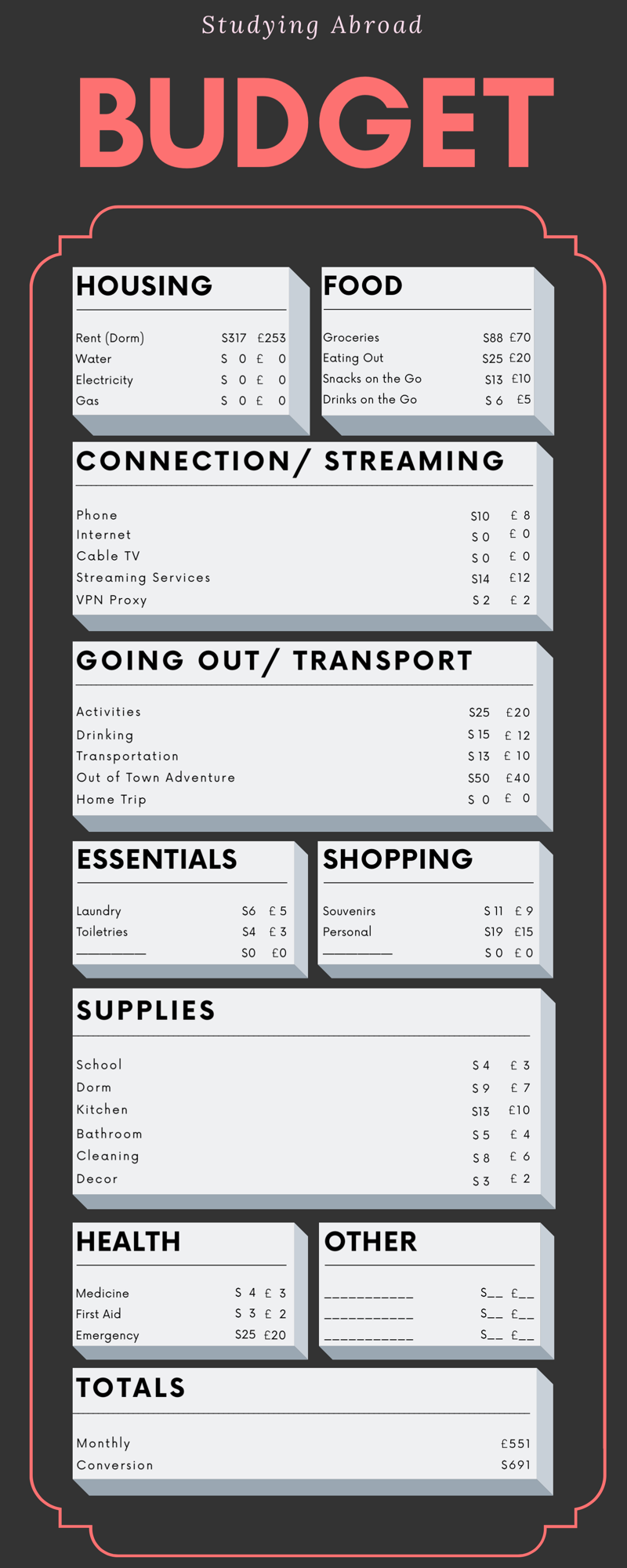
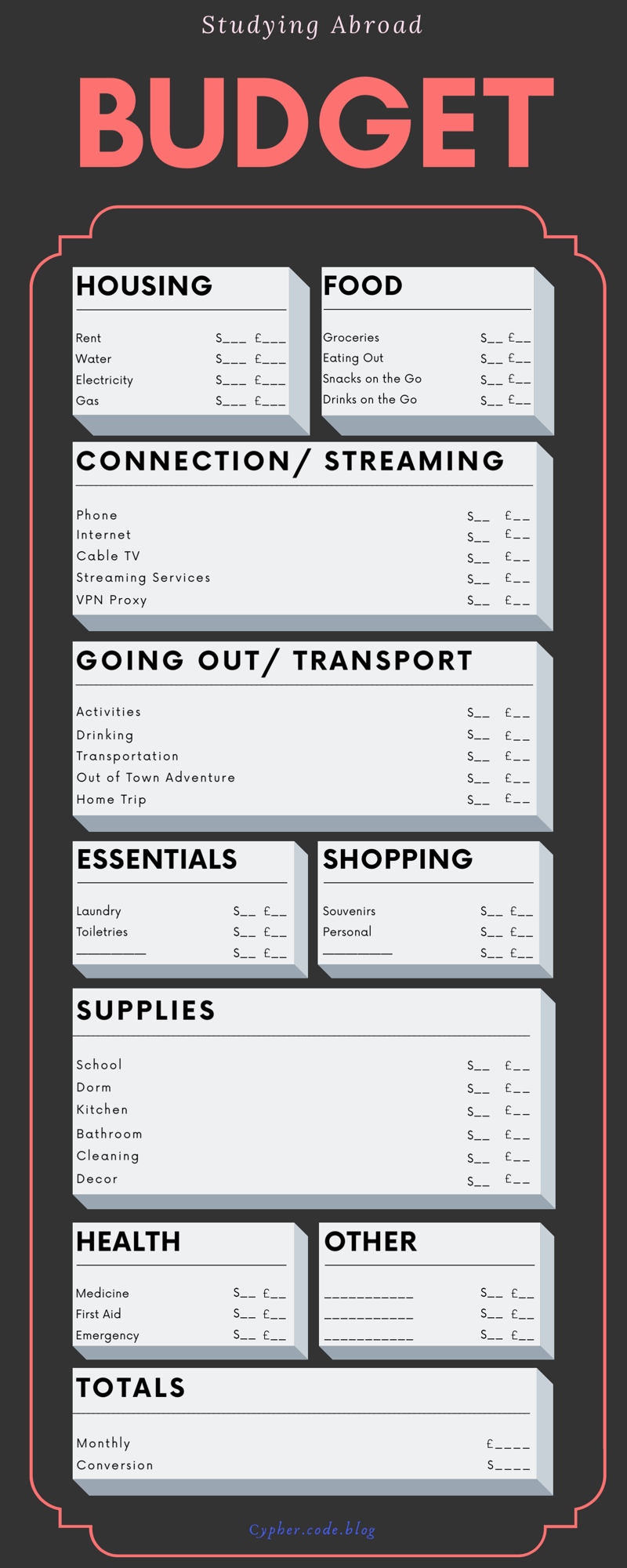
So to summarize, the big categories to plan a budget are housing, food, connection/ streaming, going out/ transportation. shopping, supplies, and medicine. You can also include an little extra for anything that comes up or if you know of anything specific you’ll need. Here I have a little worksheet I used when planning my own budget. I’ve also included a blank one at the end.

The numbers come from what research I’ve found about St. Andrews and my own experience. As I have yet to go abroad, my numbers are subject to change. I’m also using both pounds and dollars to make it easier for me to see how much I’ll actually be spending. If studying abroad for a while, you might consider opening a bank account there. Some banks offer deals for international students but fees can build up and end up costing a lot. I’ve been told it’s easiest and most cost-efficient to open an international bank account. This will allow you to withdraw money from anywhere there’s an ATM, depending on the bank of course. An international bank account allows you to withdraw money where and when you need it, in the currency of the country you’re in but also making it easy for anyone back home, such as your parents, to deposit money into that account.

Another tip about money I might give is try getting a job if you’re allowed. In the UK you’re allowed to work up to 20 hours a week on a tier 4 visa. This extra income can really help offset the costs of studying abroad. Just make sure your working doesn’t violate any conditions of your stay in a foreign country and you don’t earn enough to be taxed back home.

I’m always willing to help anyone with any question about budgeting or just study abroad in general. Comment or contact me and I’ll do my best to give you advice. Of course my advice comes only from personal experience and opinions so feel free to get advice from others especially if they can give specific tips for your situation.

Blank Budgeting Worksheet